How Much Space Does a Vending Machine Actually Need?

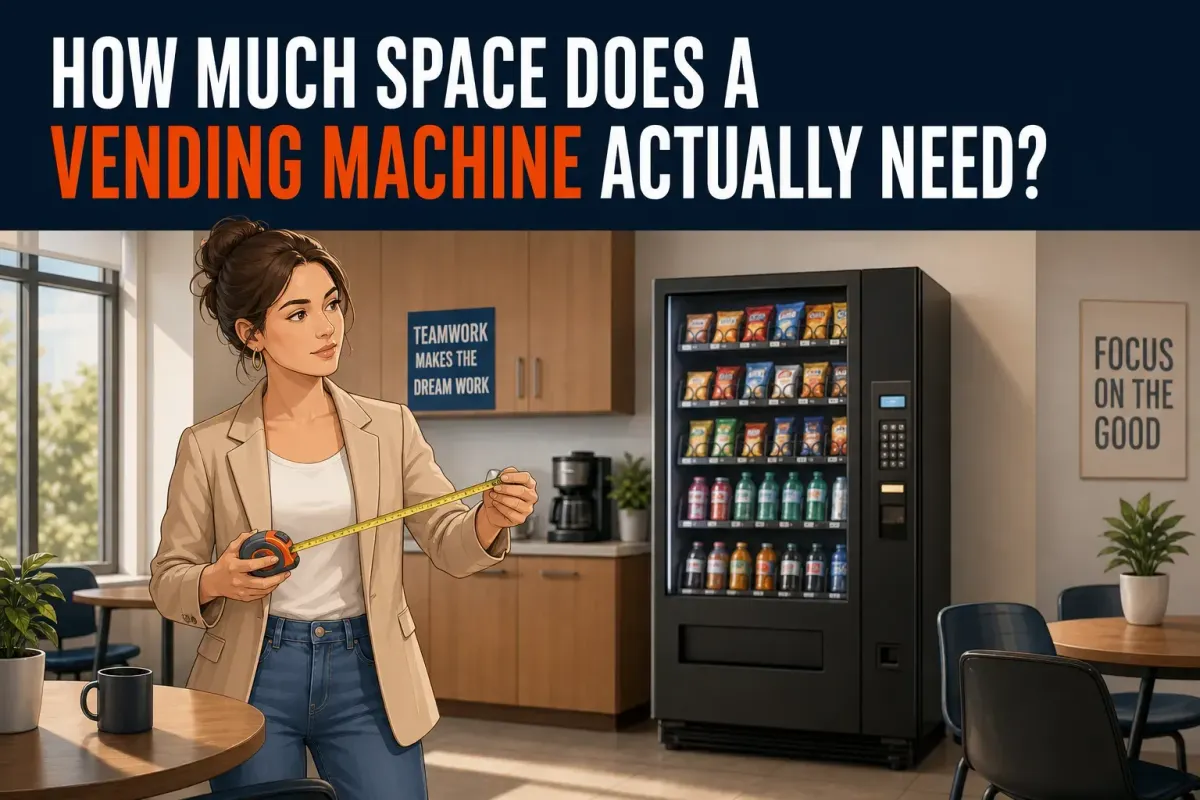
TL;DR: A vending machine usually needs less space than property managers expect. A typical machine may only need around a 2 ft x 2 ft footprint, but the final placement still needs power, access, clearance, and a spot that people will actually use.
How much space does a vending machine actually need?
For most property managers, facility managers, operations managers, and office managers, the space question comes up early. If you manage a building in New York, Vending Village also offers free vending machine service in New York through vetted local operators who can help confirm whether your space is a good fit.
They want to know if the building has enough room before requesting a machine.
In many cases, the answer is yes.
A standard vending machine often needs roughly a 2 ft x 2 ft footprint. That can vary depending on the machine type, but vending usually does not require a large dedicated room or major construction.
The bigger question is not only whether the machine physically fits.
The better question is whether the machine can be placed somewhere convenient, accessible, powered, and easy for the operator to service. That is one reason a free vending service should include a vetted local operator who can review the space, install the machine, stock it, and service it at no cost to the property.
That is where the decision should be made.
Space planning is not only about fitting the machine. The operator also needs reasonable access for stocking, cleaning, maintenance, and service visits. Property staff should not be responsible for managing those tasks themselves. We explain the division of responsibilities in our guide on who stocks and maintains vending machines at a commercial property.
The machine footprint is only part of the space question
When we talk about vending machine space, the machine footprint is only one piece of it.
A machine may fit in a 2 ft x 2 ft area, but the property still needs to think about:
- Room for people to stand in front of it
- Hallway clearance
- Nearby power
- Accessibility
- Visibility
- Operator access for restocking
- Whether the spot is convenient for employees, tenants, or visitors
A vending machine should not feel like it was squeezed into the only leftover corner.
If people have to search for it, walk too far out of their normal path, or go up a flight of stairs to use it, the machine may not get regular use.
That matters because the operator is not just placing equipment. They are servicing a location. The machine needs to be used enough to justify stocking, maintenance, and ongoing service.
If you are replacing an existing vending operator, this is also a good time to review placement before the new machine arrives. Do not only focus on removing the old machine. Confirm the new operator is ready, check the preferred location, and avoid creating a long service gap for employees or tenants. For a simple transition plan, read How Do I Switch Vending Operators Without Disrupting My Building?.
When a larger space makes sense
A small footprint may be enough for one machine, but a larger space can create more options.
If the property has enough demand, more space may allow for more machine options. That is where it can help to compare a snack machine vs drink machine before deciding what type of setup makes the most sense for the building.
More space may allow for:
- A larger snack machine
- A drink machine
- A combo machine
- Multiple machines
- A better product mix
- More capacity for a larger employee or tenant base
- Easier servicing and restocking
This matters in higher-traffic properties.
A small office may only need one compact machine. A larger workplace, apartment building, warehouse, or facility may need more capacity to serve more people.
From what we see at Vending Village, the best setup is not always the smallest machine that can fit. It is the setup that matches the number of people on-site, the product needs, and how often the operator will need to service the machine.
Restocking access should be part of the placement decision. Even if a machine physically fits in a tight corner, the operator still needs room to open the machine, bring in products, and service it without blocking the area. A better placement makes the machine easier to use and easier to maintain. Here is a simple breakdown of how often someone will come to restock the vending machine
What property managers should check before choosing a spot
Before saying yes to a vending machine location, the property should check a few practical details.
Is there a nearby outlet?
Most vending machines need standard power access.
The outlet should be close enough that the machine can be installed safely without running cords across walkways or creating a hazard.
Power is one of the first things an operator will want to confirm.
Is there enough hallway clearance?
A vending machine should not block traffic flow.
If the machine is going in a hallway, lobby, break room, common area, or staff space, there should still be enough room for people to move safely around it.
This is especially important in busy buildings where employees, tenants, visitors, carts, or equipment may pass through the area.
Is the location accessible?
The machine should not create access issues.
Property managers should think about whether the placement works for the people who will use it and whether it creates any accessibility concerns.
A machine that technically fits but makes the area harder to navigate is not a good placement.
Is the spot convenient for users?
This is the part that gets missed most often.
The best spot is not always the spot that is most convenient for management.
It is the spot that is most convenient for the people who will actually use the machine.
If employees have to go up a flight of stairs, leave their normal work area, or walk to a low-traffic corner of the building, usage may be weaker.
A better placement is usually near the natural flow of the property.
That may include:
- Break rooms
- Staff lounges
- Common areas
- Lobbies
- Amenity areas
- Near time clocks
- Near lunchrooms
- Shared tenant spaces
- High-traffic employee areas
Visibility and convenience matter.
The biggest space-related mistake
The biggest mistake is choosing a spot that works on paper but does not work for the actual users.
A machine may fit perfectly in a back hallway, upstairs corner, storage-adjacent space, or quiet management area.
But if employees, tenants, or visitors do not naturally pass that spot, the machine may not perform well.
In my opinion, vending placement should start with user behavior.
Where do people already go during breaks?
Where do they naturally pass during the day?
Where would they actually stop for a drink, snack, coffee, or quick item?
That is usually a better starting point than asking where there happens to be empty wall space.
The operator should confirm final placement
The property can suggest a location, but the operator should help confirm the final placement before installation.
A good operator should review:
- Machine type
- Available space
- Power access
- Visibility
- Hallway clearance
- Accessibility
- Delivery path
- Service access
- Product needs
- Expected usage
This is important because the operator has to service the machine after it is installed.
They need to be able to deliver it, stock it, maintain it, and move around it safely. They also need the machine placed somewhere people will actually use it.
A site visit or placement review can help avoid problems before the machine arrives.
Final answer: vending usually does not need much space, but placement matters
So, how much space does a vending machine actually need?
A typical vending machine may only need around a 2 ft x 2 ft footprint, depending on the machine type. If a larger space is available, the operator may be able to recommend a setup that serves more people or offers more product variety.
But the footprint is not the only thing that matters.
The machine also needs power, clearance, accessibility, service access, and a convenient location for the people who will use it.
For property managers and facility leads, the best approach is simple: identify a practical spot, make sure it is visible and easy to access, and let the operator confirm whether the machine type fits the space before installation.